
compound wall — from precast RCC and RR masonry to gabion and metal grill systems — based on soil type, climate, and budget.
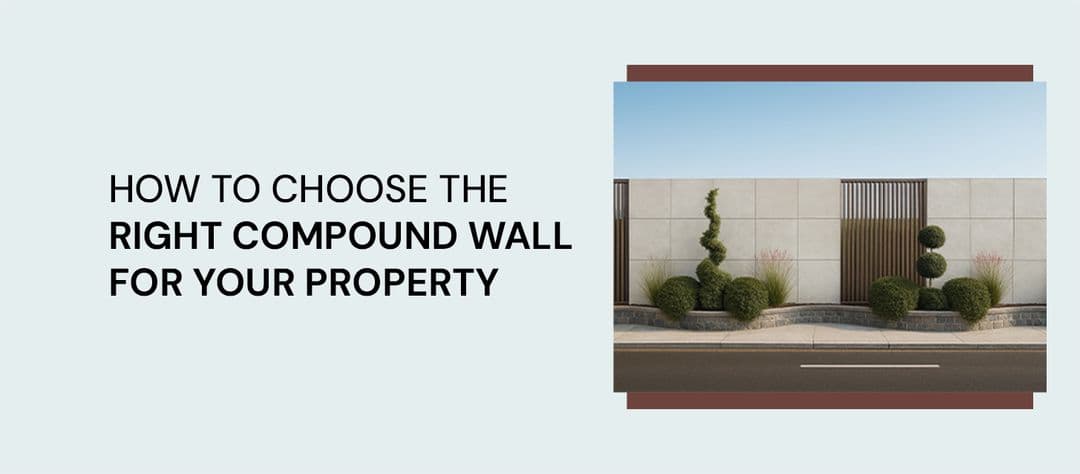
A compound wall is the first protective structure built on a plot, whether it is a boundary wall for a residential plot in the city or a boundary wall for a farmhouse in the countryside. It plays a vital role in safety, privacy, protection against wind and noise, and improving the real estate value of your land.
In India, the right compound wall construction depends strongly on factors such as soil strength, groundwater level, climatic exposure, and long-term maintenance expectations. With several compound wall types available — from precast RCC compound walls to RR stone masonry walls to gabion compound walls — selecting the ideal system requires understanding the engineering behind them.
Homeowners today also consider sustainability, durability, speed of installation, and overall compound wall cost per running foot when planning. With this guide, you’ll be able to identify the best compound wall for a home in India or choose affordable boundary wall options for farms, commercial layouts, and industrial properties.
Here are the most widely used compound wall types in India today
This hybrid system uses RR stone for the base and brick/block masonry above. The lower portion resists moisture and accidental impact, while the upper masonry makes architectural finishes easier.
This system offers a balanced approach — neither too premium nor too basic — often preferred as a cost-effective compound wall construction in medium-budget home projects.
Advantages
Disadvantages
The brick masonry compound wall is traditionally used for homes requiring privacy, sound reduction, and a premium exterior finish. A 230 mm thick masonry section built over RCC strip footing is most common.
This wall type allows waterproof plastering, stone cladding, and decorative copings — making it extremely suitable as a boundary wall for residential plots.
Advantages
Disadvantages
Brick masonry compound walls are one of the most commonly used compound wall types in India due to their durability, strength, and cost-effectiveness. Constructed using burnt clay bricks and cement mortar, these walls can be built as half-brick thick or one-brick thick compound walls, depending on height, security needs, and local building regulations. Burnt clay brick compound walls may be plastered for a smooth finish or left exposed for a traditional aesthetic, while fly-ash brick compound walls and concrete brick compound walls offer long-lasting performance, uniform finish, and moderate construction cost. For enhanced stability and premium appearance, brick masonry compound walls with cut stone granite or irregular cut stone granite base courses are widely preferred, especially for residential plots, villas, and farmhouses. Hollow brick compound walls are suitable where reduced dead load and material efficiency are required. Additionally, brick masonry compound walls with cladding—such as stone cladding, tile cladding, or textured finishes—provide a high-end architectural look while retaining the structural reliability of traditional brickwork, making them ideal for modern homes, luxury villas, and gated properties.
An RR stone masonry wall uses natural stone, making it an excellent, strong compound wall for weak soil, rocky sites, and heavy rainfall locations. With a thickness of 300–450 mm, the wall acts as a gravity structure resisting overturning and water splash erosion.
This is especially suitable for farmland and hilly regions — the first recommendation for a farmhouse compound wall in India, where sustainability and longevity matter.
Advantages
Disadvantages
Combining a masonry base with a steel grill on top, this provides visibility and ventilation — ideal for corners and commercial buildings. Grill designs can enhance the elevation, making this system attractive for premium homes
Advantages
Disadvantages
The grill may be easier to breach
5 Chain-Link Fencing Wall
The chain-link fencing wall is among the most affordable boundary wall options, particularly suitable for agricultural lands, industrial layouts, and sports grounds.
Many farmers choose chain-link fencing for farmland because it allows wind passage, crop visibility, and monitoring from outside.
Advantages
Disadvantages
This system uses RCC columns at intervals with brick masonry infilled between them. It is ideal for soils prone to differential settlement, where RCC posts and brick infill walls perform better than plain masonry.
Advantages
Disadvantages
A compound wall with a pile foundation is the only safe structural option for reclaimed land, marshy soils, and plots with very low bearing capacity. Piles transfer loads to a deeper and stronger layer.
This is the top choice for a strong compound wall for weak soil near lakes, river banks, or coastal regions.
Advantages
Disadvantages
The gabion compound wall is an excellent, eco-friendly compound wall option. It is formed by zinc-coated or PVC-coated wire baskets filled with stone. This provides drainage benefits, making it suitable for slopes and erosion-prone areas.
This system remains popular for farmhouse entrances and resort landscapes due to its attractive natural character and sustainability, often searched for as gabion wall benefits while planning rural architecture.
Advantages
Disadvantages
This visually premium wall uses RR stone for the base and high-quality exposed red bricks above — giving a timeless character. It is widely used in farm villas, heritage-style homes, and upscale residential developments.
Advantages
Disadvantages
The precast RCC compound wall is cast and cured within a factory using M25–M30 grade concrete and steel reinforcement. It is ideal when speed, quality, consistency, and sleek aesthetics are priorities. Installation is rapid as reinforced concrete panels are inserted between RCC columns that are anchored in isolated footings.
This modern system is increasingly chosen where faster construction is required for farmhouse compound wall ideas, schools, gated communities, and large industrial layouts. It also performs well when comparing precast vs brick compound walls, especially for long boundaries.
Advantages
Disadvantages
By -
Content Manager

.png&w=3840&q=50)


.png&w=3840&q=50)