
Building a compound wall on flat land is relatively straightforward. However, when the land has slopes, uneven levels, or varying soil conditions, proper planning becomes essential. Without the right approach, compound walls may develop cracks, tilt over time, or suffer from drainage issues during heavy rains.
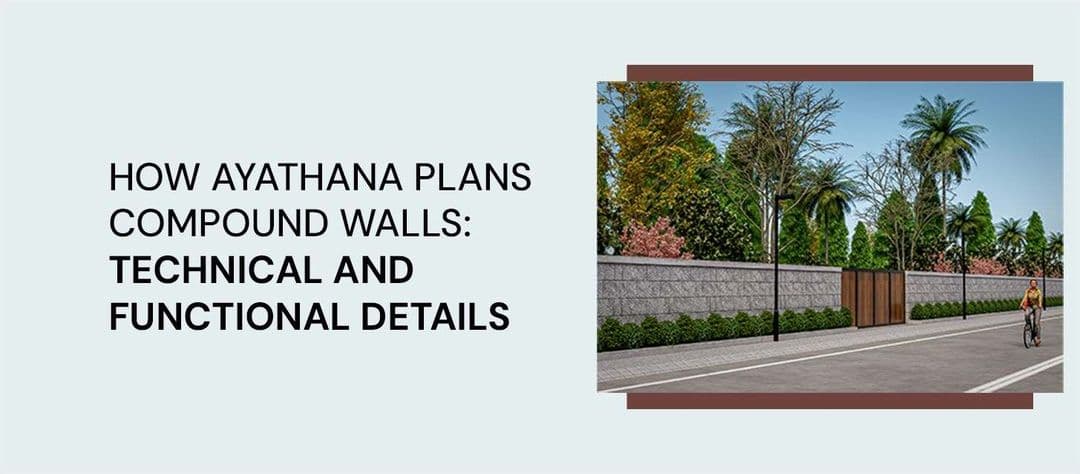
At Ayathana, compound walls are not treated as simple masonry structures. They are designed as structural systems that respond to soil conditions, slope differences, drainage flow, and boundary alignment. Our professional process ensures that every compound wall is strong, stable, and aligned with your land’s natural characteristics.
From careful site assessment to structural planning and quality execution, Ayathana ensures your compound wall protects your land while maintaining durability and visual appeal.
Every site behaves differently. Slopes, soil type, and drainage patterns can significantly affect how a compound wall performs over time. That is why Ayathana begins every compound wall project with a detailed site study before finalizing the wall design.
Before construction begins, accurate boundary marking and measurements are essential. Even small errors in alignment can lead to property disputes or loss of land area.
Ayathana verifies:
For larger plots, professional surveyors may be involved to ensure precise boundary marking. This prevents encroachments and legal complications, ensuring that your entire property is properly enclosed with a well-planned compound wall.
If you want professional guidance on compound wall planning and boundary layout, 👉 Contact Us and our team will assist you with the complete process.
Land with slopes requires special structural planning to ensure the compound wall maintains consistent height and long-term stability.
During the site study, Ayathana evaluates:
Based on these observations, stepped foundations or level adjustments are designed so the compound wall remains structurally balanced and visually consistent across the property.
Soil plays a major role in determining the stability of any structure, especially for compound walls built on uneven land or filled soil.
Ayathana assesses:
The foundation depth, footing size, and reinforcement requirements are designed based on the soil’s bearing capacity.
Proper soil assessment helps prevent:
For expert support in designing compound walls based on soil conditions, 👉 Contact Us and our specialists will evaluate your site.
Once site conditions are clearly understood, the next step is designing a compound wall system that responds to the terrain and soil characteristics.
The strength of any compound wall begins with its foundation. Ayathana designs foundations based on soil conditions, slope levels, and structural load requirements.
This includes:
These structural measures ensure that compound walls remain stable even when the land has varying levels or weak soil conditions.
Road levels often change over time due to road widening or infrastructure development. If wall height is not planned properly, it may cause:
Ayathana designs compound wall height based on:
This ensures that the compound wall maintains its intended height, security, and functionality for years to come.
Long compound walls are exposed to temperature variations and soil movement, which can cause cracks over time.
To prevent this, Ayathana incorporates:
These design elements help maintain the structural integrity and durability of compound walls.
Different sites require different construction methods. Ayathana helps clients choose the most suitable compound wall type based on site conditions, budget, and design requirements.
Common compound wall options include:
Each option is evaluated based on:
If you are unsure which compound wall type is suitable for your land, 👉 Contact Us and our experts will recommend the best solution.
Water accumulation is one of the biggest threats to compound wall stability, especially on sloping land.
Ayathana ensures proper drainage planning by:
Effective drainage planning helps protect the compound wall from moisture damage, soil erosion, and structural weakening.
Modern compound walls often include additional functional features that improve safety, lighting, and automation.
Ayathana plans these elements during the design stage itself, which avoids future wall damage during installations.
These may include:
Planning these features early ensures a clean, organized, and future-ready compound wall design.
If you want a compound wall that integrates lighting, automation, and security systems, 👉 Contact Us to discuss your requirements.
By -
Content Writer

.png&w=3840&q=50)


.png&w=3840&q=50)